
The part I believe many businesses are getting wrong is that they think AI visibility is just another SEO metric and is all about whether your brand appears in an AI answer. While being mentioned is useful, it's actually only one layer of the problem.
The real question is whether AI systems like ChatGPT, Gemini, Perplexity, and more can understand what your business does, describe it accurately, cite the correct sources, position it against the right competitors, and surface it for the questions buyers are actually asking.
Your brand can appear in AI search and still have a visibility problem:
- You might be mentioned in the wrong context
- You might be described too vaguely
- You might show up for awareness prompts, but disappear when buyers ask comparison questions
- You might be cited by third-party sources you don't control
- You might appear less often than your competitors
- Or you might be visible but not trusted
That's why you need to treat AI visibility as a brand, content, authority, and measurement issue, and not just another SEO metric.
What is AI visibility?
AI visibility is how often, how accurately, and how favourably your brand appears in AI-generated answers across tools such as ChatGPT, Google AI Overviews, Gemini, Perplexity, and more.
It includes brand mentions, citations, sentiment, share of voice, source quality, prompt coverage, and whether your brand is recommended in the right buying situations. In simple terms, AI visibility answers four questions:
-
Are you showing up?
-
Are you being described correctly?
-
Are you being cited from sources you trust?
-
Are you appearing when buyers are actually making decisions?
If you only answer the first question, you don't have the full picture.
Mistake 1: Treating AI visibility like a rankings report
The first mistake is treating AI visibility as if it works like traditional SEO rankings. In SEO, we're used to this thinking:
-
Are we ranking first?
-
Are we on page one?
-
Have we moved up or down?
-
How much traffic did that keyword bring in?
That logic doesn't fully translate to AI search.
AI answers aren't just lists of links. They're generated responses built from multiple signals, sources, and interpretations. The answer engine may mention your brand, cite your website, cite a competitor, pull from a review site, include a third-party article, or answer the question without sending the user anywhere.
That means the issue isn't just about whether you're ranking, but what answer the buyer received and what role you played in shaping that answer. This switch is a different measurement problem than what most businesses are used to.
Your business could rank well on Google yet still be absent from AI search results. One of your blog posts could lose traffic, but still influence an excellent AI-generated response. Your biggest competitor could appear in AI recommendations because they're better represented across third-party sources, even if your website is stronger.
That's why AI visibility reporting needs more than a position tracker. Your focus needs to be on prompt tracking, citation analysis, sentiment, share of voice, branded search, AI referral traffic, and eventually commercial impact.
.webp?width=950&height=580&name=Jonaz-front-of-whiteboard%20(2).webp)
Mistake 2: Measuring mentions without understanding meaning
A mention isn't always a win, and here's where AI visibility gets more complicated.
If an answer engine mentions your brand, that might look positive in a dashboard. But you still need to understand the context behind it.
-
Was your brand recommended?
-
Was it listed as one option among many?
-
Was it described accurately?
-
Was it associated with the right service?
-
Was it positioned as suitable for the right type of customer?
-
Was it compared favourably or unfavourably against competitors?
Here's an example to highlight the differences.
-
Avidly is a HubSpot partner: This is technically visible.
-
Avidly is a global HubSpot consultancy suited to complex HubSpot implementations, CRM migrations, RevOps, and enterprise enablement: This is both technically visible and also commercially useful.
This distinction matters. You should chase mentions for the sake of it. Instead, look at whether AI systems are building the right understanding of your brand. This is where description quality and sentiment become important.
If AI search describes your brand in vague, outdated, incomplete, or inaccurate terms, you have a serious positioning problem, not a visibility one.
Mistake 3: Tracking the wrong prompts
A lot of AI visibility work starts with the wrong questions. Businesses tend to play it safe and test broad prompts such as:
-
What is CRM?
-
What is AEO?
-
What is marketing automation?
-
What is HubSpot?
Those questions can be useful for education, but they aren't always useful for measuring commercial visibility. A buyer asking “what is CRM?” is probably learning. They may not expect a vendor recommendation, they may not be comparing partners, and they may not be close to choosing a solution.
The more useful AI visibility questions are usually a lot more specific. For example:
-
What's the best HubSpot partner for a multi-country CRM implementation?
-
How should a B2B company improve HubSpot adoption across sales and marketing?
-
What should we look for in a HubSpot CRM migration partner?
-
How do we improve AI visibility for a B2B website?
-
What are the common mistakes when implementing HubSpot in an enterprise business?
Those prompts are more likely to reveal whether your brand is visible in the moments that matter. They're specific, they reflect buyer intent, and they create space for brands, solutions, partners, and comparison.
The quality of your prompt set shapes the quality of your AI visibility reporting. If you're tracking vague prompts, then you'll get vague insights.
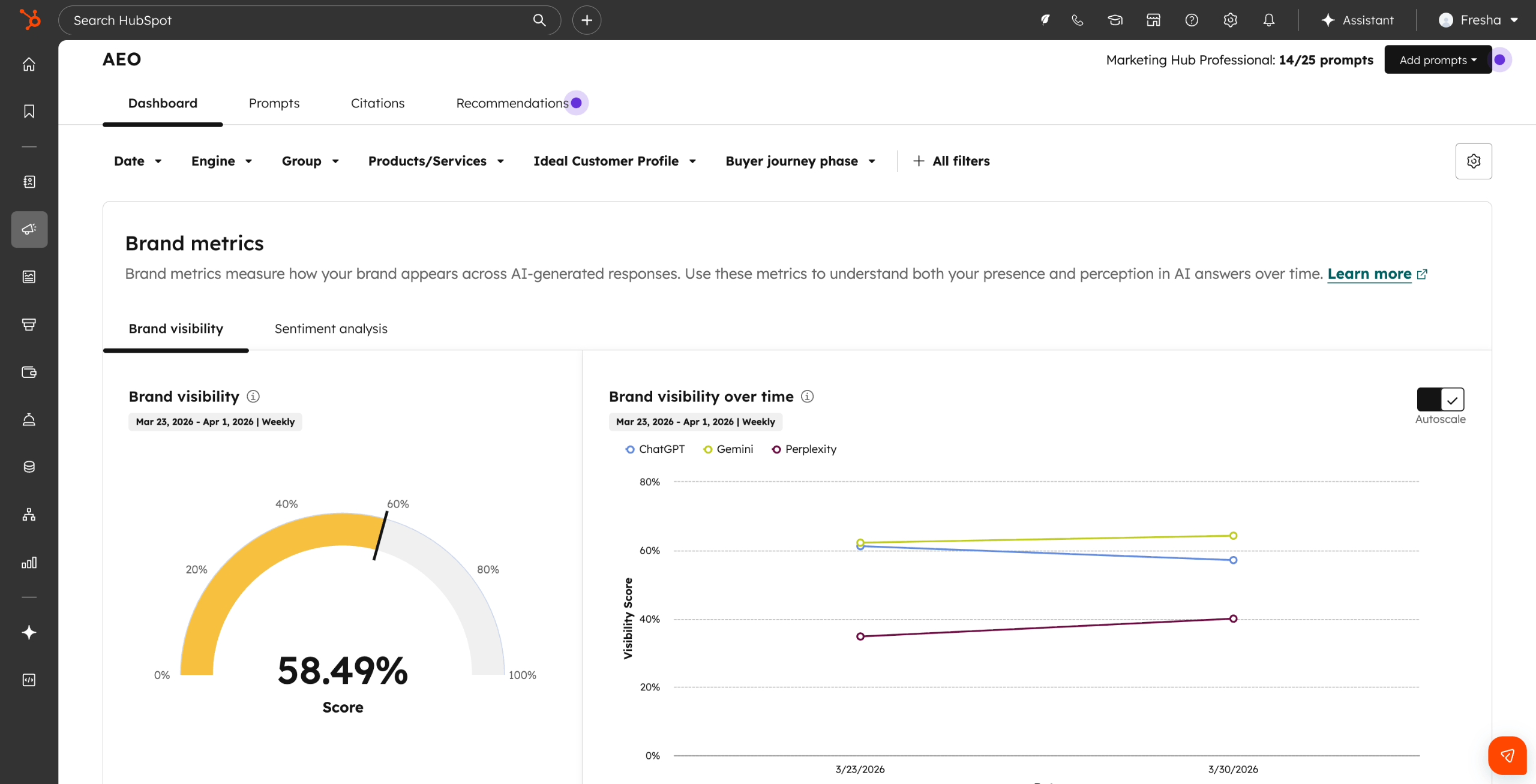
If you're struggling to track prompts and see where your brand appears, a great place to start is with HubSpot's AEO tools. It helps show how often your brand appears across ChatGPT, Gemini, and Perplexity, how that visibility compares with competitors, which pages and domains are being cited, and what actions to prioritise next.
Use it properly and prompt tracking will become a great way to connect your buyer questions, content gaps, competitor visibility, and practical optimisation work right inside HubSpot.
Mistake 4: Assuming your website is all that matters
Yes, your website matters, but it isn't the whole AI visibility ecosystem. This is one of the biggest changes marketers need to get their heads around.
AI systems don't just learn about your brand from your own website. They can be influenced by third-party articles, partner pages, review platforms, directories, community discussions, social content, YouTube, podcasts, news coverage, and pretty much every public source.
That means your website might say one thing, while the wider web says something weaker, older, or less specific.
This creates a big problem. You can have a well-structured website and still struggle to appear in AI-generated answers if there isn't enough external consistency around your brand. You can also have strong brand awareness in your market but weak AI visibility, because that awareness isn't showing up in places where answer engines can find and trust it.
This is why you shouldn't treat AEO as a basic blog optimisation tactic. Owned content is important, but AI visibility also depends on off-site authority, which can include:
-
Review profiles
-
Partner listings
-
Industry roundups
-
Guest articles
-
Podcast appearances
-
Webinar pages
-
Case study mentions
-
Social proof
-
Community discussions
-
Comparison pages
-
Third-party citations
The goal is to make your expertise and positioning consistent across the places buyers and answer engines look for evidence.

Mistake 5: Confusing citations with control
Citations matter because they show which sources are shaping the answer, but that isn't always a good thing either.
If AI cites your own page, you have more control over the framing, which is usually useful. If AI cites a third-party page that mentions your brand, you're visible, but someone else is shaping that narrative.
If AI cites a competitor’s page, your competitor may be influencing how the buyer understands the category. And if AI cites an outdated article, your brand may be described using old positioning.
This is why citation analysis is so important, because it helps you answer:
-
Which sources do AI systems use when describing your category?
-
Are your owned pages being cited?
-
Which competitor pages are influencing the answer?
-
Which third-party sites carry authority in this topic?
-
Are you mentioned in the sources AI already trusts?
-
Do your most important pages make the answer clearer?
Appearing is just one piece of the puzzle. AI visibility is also about understanding whose content is doing all of the explaining, which is where the real opportunity lies for businesses.
If your brand is mentioned but not cited, or cited through sources you don't control, you'll need to strengthen owned content. If third-party publications dominate the answer, outreach and authority building may matter more than another blog post.
Mistake 6: Looking for instant certainty
AI visibility data isn't as stable as traditional reporting. The same prompt can produce different responses over time, the answer may vary by platform, and it may change as models update, sources shift, competitors publish new content, or the user’s context changes.
That makes AI visibility harder to report with absolute certainty, which most management teams struggle to come to terms with, but it doesn't make it useless either. It means businesses like yours need to look for patterns rather than overreacting to one result.
One prompt on one day isn't a strategy. A better approach is to track a focused set of buyer prompts consistently over time, and then look for directional movement:
-
Are you appearing more often?
-
Is the description becoming more accurate?
-
Are competitors appearing where you're absent?
-
Are your owned pages being cited?
-
Are third-party sources shaping the answer?
-
Are AI referrals increasing?
-
Is branded search moving?
-
Are sales conversations starting to reference AI discovery?
Mistake 7: Separating AI visibility from business impact
AI visibility is interesting and everybody wants in on it. But it isn't enough on its own.
From a commercial perspective, ask yourself whether AI visibility is helping the right people understand, trust, and consider your brand. That means AI visibility should eventually connect to business signals. It doesn't need to be immediate or perfect, but at least directional.
Some useful signals might include:
-
AI referral traffic
-
Branded search growth
-
Direct traffic changes
-
Engagement from AI-referred visitors
-
Form conversions from AI referral sources
-
Self-reported attribution
-
Pipeline from AI-influenced journeys
-
Sales feedback on buyer research behaviour
-
Content pages cited by AI systems
-
Comparison prompts where the brand appears
This is where I believe many businesses will struggle. They'll either dismiss AI visibility because the traffic numbers look small, or they'll overstate it because the dashboard looks exciting. Yet both reactions are risky.
AI referral traffic may be small, but high-intent. A buyer who arrives from an AI answer may already have context. Also, many buyers influenced by AI won't click immediately either. They may search your brand later, return directly, visit a review site, or speak to your sales team weeks after the first AI interaction.
The more honest and useful way to report on AI visibility is to look at the evidence you have of AI visibility influencing awareness, consideration, and demand across your business.
What should businesses measure instead?
I think a practical AI visibility model should include three layers.:
1. Search performance
This is the foundation.
-
Can search engines find your content?
-
Are priority pages indexed?
-
Do your pages rank for relevant terms?
-
Are impressions, clicks, and engagement healthy?
-
Are the technical foundations sound?
SEO still matters because AI systems need accessible, useful, authoritative content to draw from. And a weak SEO foundation makes AEO harder.
2. AI visibility
This is where you track whether answer engines are finding and using your brand.
-
Brand visibility
-
Prompt-level presence
-
AI citations
-
AI mentions
-
Sentiment
-
Share of voice
-
Competitor presence
-
Owned domain citation rate
-
Third-party citation sources
-
AI referral traffic
This layer tells you whether your brand is showing up, how it's described, who appears instead, and which sources are shaping the answer.
3. Business impact
This is where the conversation becomes more commercial and what the leadership team will most likely care about. Some useful measures include:
-
AI-referred conversions
-
Lead quality from AI referral traffic
-
Branded search trends
-
Direct traffic movement
-
Pipeline influence
-
Self-reported attribution
-
Sales feedback
-
Content-assisted journeys
This layer will frustratingly take longer to mature, but it's the layer that leadership will care about most.
This is where tools like HubSpot AEO are useful. Not because a tool can create authority for you, but because it can make the AI visibility problem easier to see and act on.
HubSpot AEO helps teams move beyond manual checking by tracking prompts, brand visibility, sentiment, share of voice, citations, competitor presence, and recommendations. That matters because most teams can't properly manage AI visibility when they rely on occasional screenshots from ChatGPT or one-off manual checks.
However, the value comes from what you do with the insights.
What a better AI visibility strategy looks like
A better AI visibility strategy starts with buyer questions, not platform tactics. Before you create more content or create another dashboard, define:
-
Who are you trying to be visible to?
-
What are they asking at each stage of the journey?
-
Which prompts would indicate real commercial intent?
-
Which competitors do buyers compare you against?
-
What do you want to be known for?
-
Which services, products, or problems matter most?
-
Where are you currently being misunderstood or overlooked?
Then build the measurement and content strategy around those answers. That usually means:
-
Creating a focused prompt library
-
Auditing priority pages for answer-first structure
-
Improving service pages so they explain the offer clearly
-
Adding stronger author expertise and proof
-
Refreshing outdated content
-
Building comparison and decision-stage content
-
Connecting blogs to service pages and case studies
-
Strengthening third-party mentions and authority
-
Reviewing citations and sentiment regularly
-
Tracking AI visibility alongside SEO and business impact
A simple AI visibility checklist
Before you assume your brand has an AI visibility problem, ask yourself these questions.
-
Are you tracking the right buyer prompts?: If the prompts are too broad, you may be measuring curiosity instead of commercial relevance
-
Are you visible for the right topics?: Appearing for generic education prompts is different from appearing in buying, comparison, or partner selection prompts
-
Are you described accurately?: Visibility is weaker if AI systems describe your brand in vague, incomplete, or outdated terms
-
Are you cited from our own content?: Owned citations give you more control over the narrative. If third parties dominate, you need to understand why
-
Are competitors appearing where you're missing?: Competitor visibility can reveal content gaps, authority gaps, or prompt areas you haven't covered properly
-
Are your pages easy to extract from?: If the answer is buried, sections are unclear, or headings are vague, AI systems may struggle to use your content
-
Are you building authority beyond the website?: AI visibility depends on a broader consensus. Your brand needs to be represented consistently across trusted sources
-
Are you connecting visibility to business signals?: Mentions are useful, but they need to be understood alongside referrals, branded search, conversions, and sales feedback.
The real problem is understanding AI visibility
The phrase AI visibility can make the problem sound narrower than it is, because it sounds like the goal is simply to appear more often. But appearing more often isn't always the right answer.
If AI systems don't understand your brand, more visibility can scale the wrong message. If your content is generic, more visibility won't magically make it more useful. If your third-party presence is weak, more owned content might not create enough authority. And if your prompts are too broad, more tracking possibly won't reveal anything commercially useful.
The goal with AI visibility is to be understood accurately, cited credibly, compared fairly, and recommended in the right buying context. That's what businesses need to get right. Remember, AI visibility isn't a vanity metric, it's a new way to see whether your market, content, and buyers understand your brand in the same way you do.
_88078632.png)
-1.jpeg?width=375&height=225&name=_DSC2806%20(1)-1.jpeg)
.jpg?width=375&height=225&name=_DSC2029%20(2).jpg)
%20(2)-1.jpg?width=375&height=225&name=_DSC1871%20(1)%20(2)-1.jpg)